






- Saw Cutting
- Shearing
- Slitting
- Straightening
- Surface Grinding
- Swaging
- Tempering
- Tapping
- Tension Leveling
- Threading
- Trepanning
- Turning
- Ultrasonic Testing
- Waterjet Cutting
- Welding
Anodizing is an electrochemical process used to modify the surface of a metal (primarily aluminum) to create a protective, durable, and highly resistant oxide layer. Unlike paint, which is a coating applied over the metal, anodizing integrates completely with the base aluminum, so it does not peel or flake off. It is widely used in the manufacture of building windows and facades, automotive and bicycle parts, electronic components (such as phone or laptop casings), cookware, and industrial tools.
Bending is the act of applying force to a straight or flat object to deform it into a curved or angular shape. It is a fundamental concept spanning multiple disciplines, most notably manufacturing, physics, and music, referring to the alteration of an object's original form. Key Applications and Definition. Manufacturing and MetalworkingIn engineering and metal fabrication, bending refers to the process of plastically deforming ductile materials (like sheet metal) to produce a V-shape, U-shape, or channel along a straight axis. Mechanics: The inner radius of the bend undergoes compression, while the outer radius undergoes tension. Tools used: Press brakes, box and pan brakes, and specialized machinery.
Beveling is a manufacturing and crafting process of cutting or shaping the edge of a material—such as metal, wood, glass, or leather—at a sloped angle that is not 90° to its surface. This technique smooths sharp corners for safety, creates decorative finishes, and helps parts fit together perfectly.
Blanchard grinding (or rotary surface grinding) is a machining method used to quickly remove large amounts of material from one side of a flat part. It uses a heavy spinning wheel positioned vertically above a rotating magnetic table that holds the metal in place.
Blanking is a manufacturing process used in sheet metal fabrication where a punch and die cut a specific flat shape out of a larger piece of metal. The piece that is cut out is called the blank and becomes the finished product, while the leftover metal is treated as scrap.
Metal blasting uses high-pressure air or water to shoot abrasive materials at a metal surface to clean rust, strip old paint, and prepare the part for a new finish.
Boring in metalworking is a machining process that enlarges, shapes, and increases the precision of a pre-drilled internal hole using a single-point cutting tool.
Metal casting is a manufacturing process that involves melting metal and pouring it into a hollow mold cavity where it cools and solidifies into a desired shape.
Precision centerless grinding services designed to achieve tight tolerances, superior surface finishes, and consistent dimensional accuracy for a wide range of metal components.
Chemical milling solutions that selectively remove material from metal surfaces, allowing for precise thickness reduction and complex part configurations without mechanical stress.
Comprehensive chemical testing services to verify material composition, quality, and compliance with industry specifications and customer requirements.
High-quality chrome plating services that improve corrosion resistance, surface hardness, wear resistance, and the overall appearance of metal components.
Custom metal fabrication solutions tailored to your exact specifications, from individual components to complete assemblies, with a focus on quality and precision. High-quality chrome plating services that improve corrosion resistance, surface hardness, wear resistance, and the overall appearance of metal components.
Specialized tube fabrication services including cutting, bending, shaping, and custom manufacturing to meet the specific requirements of your application.Custom metal fabrication solutions tailored to your exact specifications, from individual components to complete assemblies, with a focus on quality and precision. High-quality chrome plating services that improve corrosion resistance, surface hardness, wear resistance, and the overall appearance of metal components.
Precision cutting of metal coils, sheets, bars, and other materials to specified lengths, ensuring consistent dimensions and minimal material waste.
Custom cutting of metal materials to exact customer-specified dimensions, supporting tight tolerances and production requirements.
Removal of sharp edges, burrs, and unwanted material created during cutting, machining, or fabrication to improve safety, finish, and part performance.
High-precision grinding process that simultaneously machines both sides of a metal component to achieve uniform thickness, flatness, and parallelism.
Precision drilling of holes in a wide range of metals according to specified diameters, depths, locations, and tolerances.High-precision grinding process that simultaneously machines both sides of a metal component to achieve uniform thickness, flatness, and parallelism.
Precision finishing and shaping of metal edges to achieve the required profile, dimensions, smoothness, and edge condition.
Electrochemical surface treatment that removes a controlled layer of metal to produce a smoother, cleaner, and more corrosion-resistant surface.
Metal forming process that uses controlled heat and mechanical force to produce strong, durable components with enhanced structural integrity and mechanical properties.Custom metal fabrication including cutting, forming, welding, machining, and assembly to produce components and finished products according to customer specifications.
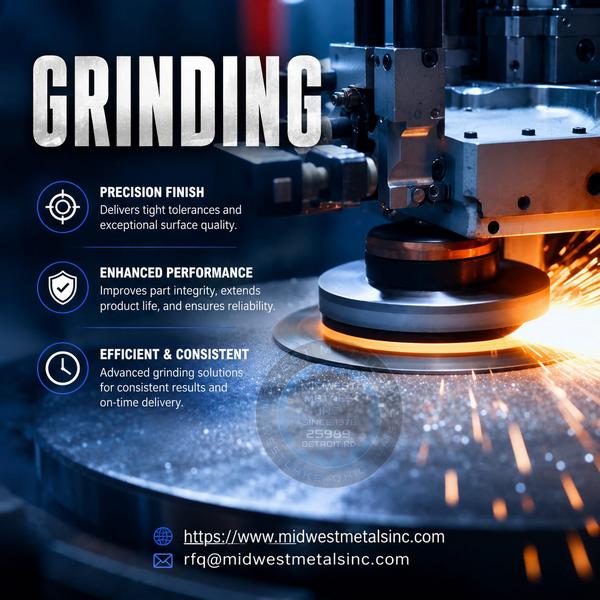
Precision grinding removes material to achieve tight dimensional tolerances, smooth surface finishes, and accurate geometries across a wide range of metals.
Grooving creates precise channels, recesses, or profiles in metal components to meet specific dimensional and functional requirements.
Gun drilling produces deep, straight, and highly accurate holes with excellent surface finishes, making it ideal for precision metal components.
Heat treating uses controlled heating and cooling processes to modify the mechanical properties of metals, including hardness, strength, durability, and wear resistance.
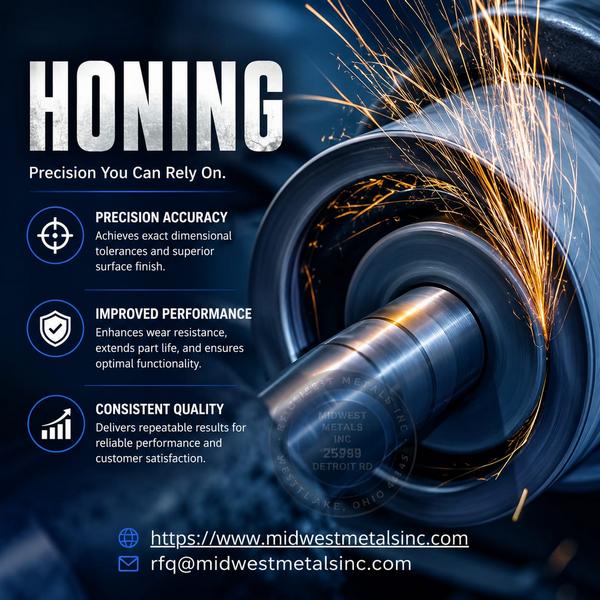
Honing is a precision finishing process that improves bore geometry, dimensional accuracy, and surface finish for critical internal diameters.
Hypro lapping provides ultra-precise surface finishing by removing microscopic amounts of material to achieve exceptional flatness, dimensional accuracy, and surface quality.
Laser cutting uses a focused, high-energy laser beam to produce precise cuts and complex profiles in metal with excellent accuracy and minimal material waste.
Laser marking permanently identifies metal components with precise text, logos, serial numbers, part numbers, barcodes, or other traceability information.
Leveling corrects flatness and removes unwanted bends or distortions in metal sheets, plates, and components to achieve consistent, uniform surfaces. Request a Quote
Mechanical testing evaluates the performance and properties of metals, including tensile strength, yield strength, elongation, hardness, and other critical characteristics. Request a Quote
Precision metal peeling removes surface imperfections from bars and tubes while improving dimensional accuracy, consistency, and surface quality for demanding industrial applications. Request a Quote
Our photo etching services produce highly detailed metal components using precision chemical etching technology, ideal for complex patterns, fine features, and tight dimensional requirements.
Metal pickling removes scale, oxides, and surface contaminants through a controlled chemical cleaning process, providing a clean surface ready for additional processing or finishing.
Our plasma cutting services deliver fast, precise cuts on conductive metals, producing complex shapes and profiles while maintaining consistent dimensions and quality.
Precision metal plating adds a protective or functional coating to improve corrosion resistance, wear performance, conductivity, durability, and appearance.
Our metal polishing services improve surface smoothness and appearance by removing minor imperfections and producing consistent finishes to meet specific customer requirements.
Powder coating provides a durable, uniform protective finish for metal components. This process enhances corrosion resistance, durability, and overall appearance.
High-volume production cutting provides accurate and repeatable metal components in specified lengths and tolerances, supporting efficient manufacturing and large production runs.
Profile grinding produces precise contours, complex geometries, and detailed profiles while maintaining tight tolerances and consistent surface finishes for precision components.
Our metal punching services create accurate holes, slots, and custom shapes in sheet and plate materials with efficient, repeatable production capabilities.
Re-rolling adjusts metal thickness, dimensions, mechanical properties, and surface characteristics to meet specific material requirements and tight production specifications.
Rolling and welding combines precision metal forming with controlled welding processes to manufacture cylinders, formed sections, assemblies, and custom metal components.
Rotary grinding provides precision material removal, improved flatness, tight dimensional control, and consistent surface finishes for a wide range of metal components.